
informational Pillar guide 7 min read
Inside Westminster Abbey: What You Will See
Updated October 27, 2026
Short answer: yes, you can go inside Westminster Abbey, Monday to Saturday with a timed ticket (£32 adult on the Abbey’s own site, about $43). Inside you see the tallest Gothic nave in England, the grave of the Unknown Warrior, the 700-year-old Coronation Chair, the tombs of Tudor and medieval monarchs in the Lady Chapel, Poets’ Corner, the Cloisters and the Chapter House. The Queen’s Diamond Jubilee Galleries, high above the floor, need a separate £5 ticket.
The Abbey is a working Church of England church and a royal peculiar, answerable to the monarch rather than a bishop. Services run every day, and on Sundays it opens for worship only. This guide follows the main sights in the order most people meet them. For the practical side (doors, bags, toilets) see how a visit works.
The nave and the Unknown Warrior
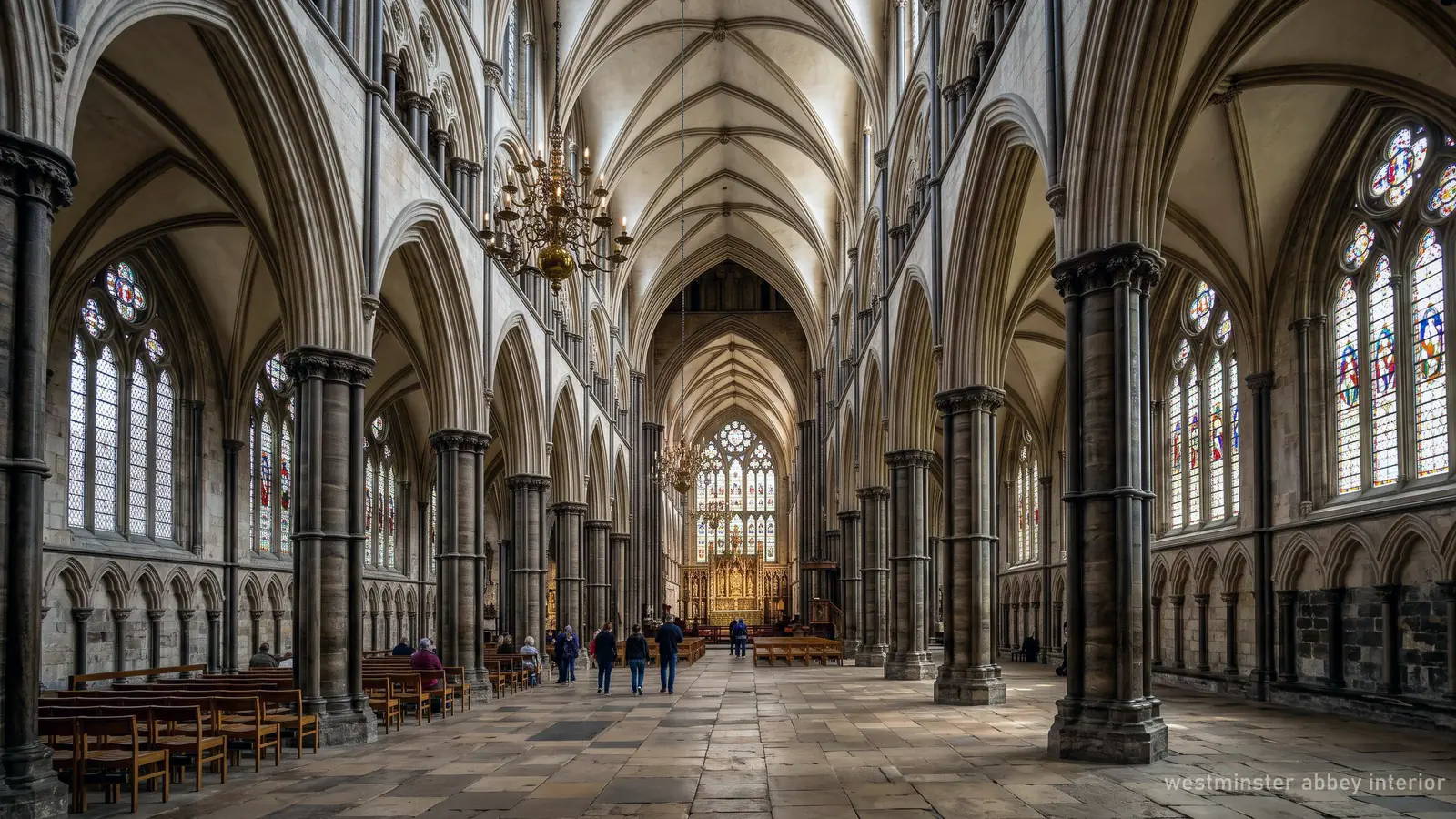
The nave is the long main body of the church, and its vault rises 102 feet (31 m). Wikipedia describes it as the highest Gothic nave in England. Henry III began the present church on 6 July 1245, and the building reached the west end of the nave only in 1495.
At the west end of the nave lies the Tomb of the Unknown Warrior, a British serviceman of the First World War buried on 11 November 1920. The slab is black Belgian marble. It is the only gravestone in the Abbey that visitors do not walk on. Read the story in our guide to the Tomb of the Unknown Warrior.
The nave is also where Britain’s best-known scientists lie:
- Sir Isaac Newton, buried 28 March 1727. His grave is in front of the choir screen, beside his monument.
- Charles Darwin, buried 26 April 1882 in the north aisle of the nave, a few feet from Newton.
- Stephen Hawking, whose ashes were interred on 15 June 2018, not far from the graves of Newton and Darwin.
More names are in our guide to who is buried in Westminster Abbey.
The quire and the high altar
The quire is where the choir sings the daily services, including Evensong. Beyond it stands the high altar, where monarchs are crowned.
In front of the high altar is the Cosmati pavement, a mosaic floor that Henry III ordered laid in 1268 by a team from Rome led by a craftsman called Odoricus. It was cleaned and conserved from 2008 and rededicated on 21 May 2010. See the Cosmati pavement.
Behind the high altar is the Shrine of St Edward the Confessor, the king who built the first great church here. Edward’s remains were moved to the present shrine on 13 October 1269. The shrine is not open to general visitors; you can reach it on a verger-led tour or at a service there.
The Coronation Chair
The Coronation Chair is the oak chair on which English and British monarchs have been crowned since 1308. Edward I had it made in 1300 to 1301 to hold the Stone of Scone, which he had brought from Scotland in 1296. It was painted by Master Walter, and schoolboys and visitors carved their names into its back in the 18th and 19th centuries.
Today it stands behind glass in St George’s Chapel, off the nave. For a coronation it is moved to the centre of the church in front of the high altar, as it was for King Charles III on 6 May 2023. Full story: the Coronation Chair.
The Lady Chapel and the royal tombs
The Lady Chapel at the east end is Henry VII’s chapel, begun with a foundation stone on 24 January 1503 and consecrated on 19 February 1516. Its ceiling is the pendant fan vault people photograph most, and the banners above the stalls belong to the Order of the Bath, whose chapel it has been since 1725.
The tombs here:
- Henry VII and Elizabeth of York, together in a vault beneath a Renaissance tomb by the Italian sculptor Pietro Torrigiano.
- Elizabeth I and Mary I, the half-sisters, in one tomb in the north aisle. Elizabeth’s coffin was placed on top of Mary’s in 1606. The inscription reads, in translation, “Partners in throne and grave, here we sleep Elizabeth and Mary, sisters in hope of the Resurrection.”
- Mary, Queen of Scots, in the south aisle, reburied here on 11 October 1612 on the orders of her son James I.
- George II, in a vault under the central aisle. He was the last monarch to be buried in the Abbey.
The Lady Chapel and these tombs are up 12 steps plus 3 more. More detail in the royal tombs of Westminster Abbey and the Lady Chapel.
Poets’ Corner
Poets’ Corner is in the south transept, and more than 100 poets and writers are buried or have memorials there. It began by accident: Geoffrey Chaucer was buried here in 1400 because he had been Clerk of the King’s Works, not because he was a poet.
Charles Dickens, Thomas Hardy and Rudyard Kipling are buried here. William Shakespeare and Jane Austen have memorials only; Shakespeare is buried in Stratford-upon-Avon and Austen in Winchester Cathedral. See Poets’ Corner for who is buried and who is only remembered.
The Cloisters and the Chapter House
The Cloisters, the College Garden, the Chapter House and the Pyx Chamber are all part of general admission. They are the remains of the Benedictine monastery that ran the Abbey until the Reformation.
- The Cloisters: the covered walks around the old monastic courtyard. The toilets, baby changing and the Cellarium Café are here. From the church you go down 5 steps; there is a step-free way in from Dean’s Yard.
- The Chapter House: an octagonal room built in the 1250s, where the monks met daily. English Heritage, which looks after it, notes that the King’s Great Council and the Commons, forerunners of Parliament, later met here. Its medieval wall paintings and tiled floor survive.
- The Pyx Chamber: an 11th-century room used as a monastic and royal treasury.
The galleries above
The Queen’s Diamond Jubilee Galleries sit in the 13th-century triforium, the gallery high above the Abbey floor. They need a separate timed ticket, £5 for adults and free for 17 and under, bought with your Abbey ticket. You reach them by 108 steps or by a lift in the Weston Tower.
More than 300 objects are on show. They include the Liber Regalis, the medieval order of service for coronations; 21 funeral effigies from the 14th to the early 17th century; the Westminster Retable, England’s oldest surviving altarpiece; and the marriage licence of Prince William and Catherine Middleton. The Galleries close earlier than the church (last entry 2:00pm on weekdays) and photography is not allowed. See the Queen’s Diamond Jubilee Galleries.
Seeing it with a guide or on your own
Every ticket includes a multimedia guide in 14 languages. On your own, the Westminster Abbey entrance ticket is $43 with free cancellation up to 24 hours before; it is not skip-the-line. If you want someone to tell you the stories as you walk, a skip-the-line guided tour of the Abbey from $100 uses the priority group entrance, and the VIP tour with the Galleries ($179) is the only listing we sell that includes Galleries tickets. Compare them all on our tours page.
Check prices & dates
Book your tickets in advance: popular time slots sell out.
Book Westminster Abbey Tickets
From$43per person
Check availability- Free cancellation up to 24h
- Reserve now, pay later
- Multimedia guide or live guide included
Frequently asked questions
Can you go inside Westminster Abbey?
Yes, Monday to Saturday with a ticket (£32 adult on the Abbey's site), or free at a service. On Sundays it is open for worship only.
What is Westminster Abbey most famous for?
It has been the coronation church since 1066, it holds the tombs of kings and queens from Henry III to George II, and Poets' Corner has the graves and memorials of more than 100 writers.
Is Queen Elizabeth buried in Westminster Abbey?
Elizabeth I is, in a tomb she shares with her half-sister Mary I in the Lady Chapel. Elizabeth II is not: her state funeral was held in the Abbey, but she is buried at St George's Chapel, Windsor Castle.
How long does it take to see inside Westminster Abbey?
The Abbey's FAQ says 1.5 to 2 hours for the main highlights and 2 to 3 hours with the Galleries, Cloisters and the full audio guide.
Sources