
informational 6 min read
Westminster Abbey History: What It Is and Why It Matters
Updated October 27, 2026
Short answer: Westminster Abbey is a Church of England church in central London, founded as a Benedictine monastery around 959 and rebuilt in Gothic style from 1245. It has been the coronation church since 1066, it holds the tombs of 17 monarchs by Wikipedia’s estimate, and since 1560 it has been a royal peculiar, answerable to the monarch rather than a bishop. Its formal name is the Collegiate Church of Saint Peter at Westminster.
The Benedictine monastery and Edward the Confessor
The Abbey began as a monastery. Wikipedia dates the origins of the community to about 959, when Benedictine monks were installed under Dunstan and King Edgar.
The first great church came a century later. Edward the Confessor began rebuilding the abbey church between 1042 and 1052. It was consecrated on 28 December 1065, about a week before Edward died on 5 January 1066. That timing made the church the stage for what came next: William the Conqueror was crowned here on Christmas Day 1066, and the Abbey says it may have been chosen to show William as Edward’s legitimate heir.
Henry III’s Gothic rebuilding
The church you visit today is mostly the work of Henry III, whose building work began on 6 July 1245. The new Gothic church was consecrated on 13 October 1269, the day Edward’s remains were moved to the shrine behind the high altar where they still lie.
The design followed French Gothic, especially Reims Cathedral, rather than the English cathedrals of the day. That explains the tall, narrow nave: its vault reaches 102 feet (31 m), the highest of any Gothic church in England.
Building went on for centuries:
- 1495: the work reached the west end of the nave.
- 1503 to 1516: Henry VII’s Lady Chapel was built at the east end.
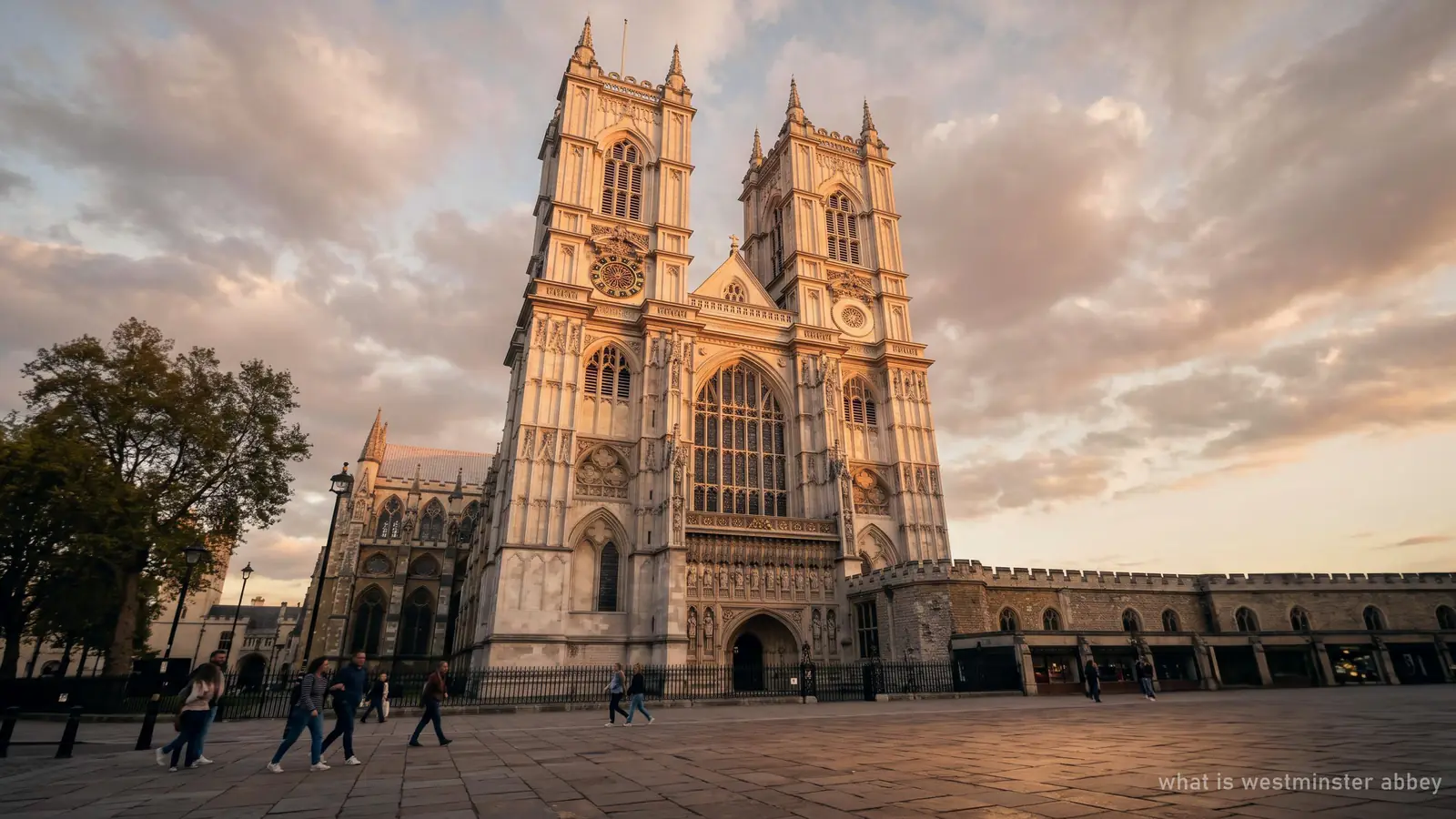
- 1740s: the two west towers were added by Nicholas Hawksmoor and John James.
For the details of the building, see Westminster Abbey architecture and when Westminster Abbey was built.
The Reformation and the royal peculiar
Henry VIII’s seizure of the monasteries in the 1530s ended the monastery. The church survived, first as the cathedral of a new Diocese of Westminster, which was dissolved in 1550, and then as a second cathedral of the Diocese of London until 1556.
In 1560 Elizabeth I gave the Abbey the status it still has. She made it a royal peculiar, a church under the monarch’s direct authority, and renamed it the Collegiate Church of Saint Peter. That is why the Abbey is not a cathedral and has no bishop. It is run by the Dean and Chapter: a dean and several canons. It is Church of England, not Catholic; the Catholic cathedral in the area is Westminster Cathedral. See is Westminster Abbey Catholic?.
Coronations, weddings and funerals
The Abbey is famous above all for royal ceremonies.
- Coronations: every coronation since 1066 has taken place here. King Charles III, crowned on 6 May 2023, was the 40th reigning monarch crowned in the Abbey. See coronations at Westminster Abbey.
- Royal weddings: the Abbey counts 16 royal weddings, from Henry I and Matilda of Scotland in 1100 to Prince William and Catherine Middleton on 29 April 2011. See royal weddings.
- Funerals: the funeral of Diana, Princess of Wales, was held here on 6 September 1997. The state funeral of Queen Elizabeth II, on 19 September 2022, was the first funeral of a monarch at the Abbey for more than 260 years.
- Burials: monarchs were buried here from Henry III to George II, the last monarch buried in the Abbey. See the royal tombs.
What it is used for today
Today the Abbey is a working church first. It holds services every day, from 7:30am Morning Prayer on weekdays to Evensong in the late afternoon, and on Sundays it opens for worship only. Services are free and open to everyone; see services and worship.
It is also a visitor attraction, a school site and a place of national memory. Westminster School, whose teaching goes back to the 14th century, is in the Abbey precincts, as is the Abbey’s Choir School. In 1987 the Abbey, the Palace of Westminster and St Margaret’s Church were together named a UNESCO World Heritage Site.
Facts most visitors miss
- It was bombed in the Blitz. On the night of 10 to 11 May 1941, incendiary bombs hit the roof and precincts and the lantern tower above the crossing collapsed. Damage was put at £135,000.
- Admission charges are recent. The Abbey began charging for sightseeing in 1997, when Wikipedia says it was receiving about 1.75 million visitors a year.
- Chaucer is buried here for his day job. He was Clerk of the King’s Works, which is how Poets’ Corner began in 1400.
- The Coronation Chair is older than most of the nave. It was made in 1300 to 1301; the nave was finished in 1495.
- No monarch has been buried here since George II. He lies in a vault under the Lady Chapel; every monarch who died after him is buried at Windsor.
The fastest way to hear this story on site is with a guide. A skip-the-line guided tour of the Abbey costs from $100, rated 4.9 from 549 reviews of that tour on GetYourGuide. Verger-led tours booked at the Abbey cost entry plus £10. See all options on our tours page.
Check prices & dates
Book your tickets in advance: popular time slots sell out.
Book Westminster Abbey Tickets
From$43per person
Check availability- Free cancellation up to 24h
- Reserve now, pay later
- Multimedia guide or live guide included
Frequently asked questions
Who owns Westminster Abbey?
It is a royal peculiar: since 1560 it has answered directly to the monarch, not to a bishop or archbishop. It is run day to day by the Dean and Chapter of Westminster.
Is Westminster Abbey a cathedral?
Not today. It was briefly a cathedral after the Reformation, until 1556, and since 1560 it has been the Collegiate Church of Saint Peter, a royal peculiar.
Was Westminster Abbey bombed in WWII?
Yes. Incendiary bombs hit the roof and precincts on the night of 10 to 11 May 1941, and the lantern tower above the crossing collapsed.
How old is Westminster Abbey?
A Benedictine community was established here around 959. The present church was begun in 1245 under Henry III.
Sources